


"Annotated Bibliography" (Post Three)
- tsephel123

- May 10, 2021
- 6 min read

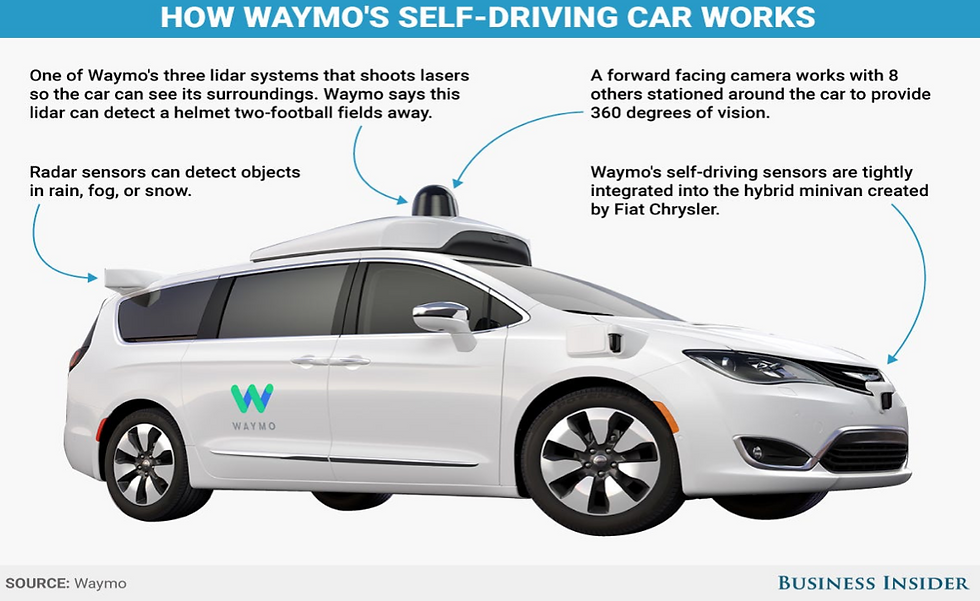
Photo of Google’s Waymo
Introduction
“Nearly 3 in 4 Americans say autonomous vehicle (AV) technology is not ready for primetime,” as stated by an American technology news website, The Verge. Well (believe it or not), in order to succeed in something, there's always going to be lots of critics judging your failures and that’s exactly what’s happening with the AV sector right now. Many critics are categorizing autonomous vehicles as a failure and as a tech to be only evolving in future of future due to the whole AV sector dwindling the release of Robo-taxi as a result of the pandemic, but several large companies like Amazon, Google, Apple, etc.. have been investing more in the autonomous vehicle sector than ever.
Shira Ovide’s “Driverless Cars Go Humble to Get Real.”

Shira Ovide, New York Times Tech reporter
Ovide, Shira. “Driverless Cars Go Humble to Get Real.” The New York Times, The New York Times, 26 Oct. 2020, www.nytimes.com/2020/10/26/technology/driverless-cars.html.
In the article “Driverless Cars Go Humble to Get Real,” author Shira Ovide asserts that although the autonomous vehicles sector has slowed down due to the pandemic, it's starting to pick up the pace where it left off before. She backs up her claim by doing the following: first, she mentioned how the whole autonomous vehicle sector slowed down showing how many miles were driven last year; next, she mentioned the issues that self-driving cars may have and how they can get around it; last, she reported companies like Google and Amazon finally being functioned in the public roads. Ovide appears to write in hopes of not only spreading positive messages about autonomous vehicles but also inspiring others who aren’t as open to being a passenger in an autonomous vehicle in order to push the progression in the autonomous vehicle sector. Because of the author's encouraging and optimistic tone, it seems as if she writes for a general and scholarly audience.
This goes well with my writing because it shows that the progression of autonomous vehicles is still on even through the midst of a pandemic. I can use this to demonstrate how much support the autonomous vehicle sector is getting from big companies like Amazon, Google, and Apple.
Kara Swisher’s “Autonomous Vehicles Take Another Big Leap.”

Kara Swisher, Host of “Sway” podcast
Swisher, Kara. “Autonomous Vehicles Take Another Big Leap.” The New York Times, The New York Times, 14 Dec. 2020, www.nytimes.com/2020/12/14/opinion/Zoox-Amazon-self-driving.html?searchResultPosition=2.
Kara Swisher, Host of the “Sway” podcast focused more on the economic side of running autonomous vehicles, in her article “Autonomous Vehicles Take Another Big Leap” published on Dec. 14, 2020, mentions how the pandemic had a huge negative economic effect on the whole autonomous vehicle sector. Swisher backs her implication by providing statistics released from the companies themselves. Her purpose is to show that although huge companies like Amazon, Google, Apple, etc. have lost so much capital from their autonomous vehicle sector due to the pandemic, they are still bullish on what autonomous vehicles can offer in the future. Because of Swisher’s optimistic and passionate tone, it seems as if she writes for an audience of autonomous vehicle scholars, who might want to study the statistics of how well the whole sector is doing in terms of economics.
These statistics being provided will be extremely important when I compare the capital loss of each company and see how optimistic these companies are for the success of autonomous vehicles despite their losses.
Andrew J. Hawkins’s “Waymo and Cruise Dominated Autonomous Testing in California in the First Year of the Pandemic.”

Andrew Hawkins in one of Waymo’s autonomous vehicles
Hawkins, Andrew J. “Waymo and Cruise Dominated Autonomous Testing in California in the First Year of the Pandemic.” The Verge, The Verge, 11 Feb. 2021, www.theverge.com/2021/2/11/22276851/california-self-driving-autonomous-cars-miles-waymo-cruise-2020.
In his article “Waymo and Cruise Dominated Autonomous Testing in California in the First Year of the Pandemic,” (Feb 11, 2021), The Verge writer Andrew Hawkins goes into the fundamental of disengagement reports (when a human driver has to step in to guide the autonomous vehicle in the right direction) and reporting what the Department of Motor Vehicles (DMV) has reported. By giving these data to the readers, Hawkins builds his claims about how companies that run autonomous vehicles have significantly reduced their number of “disengagement.” The author’s audience likely consists of those fascinated by autonomous vehicles due to his article containing mostly statistics.
This will fit very well with my whole theme of how the pandemic can slow the autonomous vehicle sector but can’t stop them from the progress that they are making. I plan to use this article to statistically support the progression of autonomous vehicles.
Bill Canis’s "Autonomous Vehicles: Emerging Policy Issues."

"Autonomous Vehicles: Emerging Policy Issues." Autonomous Vehicles: Emerging Policy Issues. Ed. Bill Canis. Congressional Research Service, 2020. Web.
Bill Canis, Specialist in Industrial Organization and Business wrote about the topic of Self-driving Autonomous vehicles (AV), arguing that the evolution of autonomous vehicles solely depends on the decisions that the federal, state, and local government makes to influence the usage of AV, in his article, "Autonomous Vehicles: Emerging Policy Issues'' published in Congressional Research Service. He supports his claim by providing details of policy issues that may affect AV deployment, such as unreliability over the delivery timeline and technologies that may be used in autonomous vehicles. Cannis’s purpose is to describe all the blueprints of having a functional autonomous vehicle before it can start driving the majority of the people around the city, and going over this policy might clear up things as far as who gets to decide if AV can function out in public roads. Because of the author’s formal tone, it seems as if he writes for an intellectual and scholarly audience.
This article provides thorough descriptions of the processes that actually take place behind obtaining autonomous vehicles on public roads. It’s useful because Cannis describes not just one but many policies in detail. The picture and details of technologies required for a functional AV will be extremely helpful when introducing this topic to someone who's not familiar with it. Including the policies from the federal, state, and local government would help distinguish the reality of having a functional AV out in the public roads.
Nidhi Kalra’s “Driving to safety: How many miles of driving would it take to demonstrate autonomous vehicle reliability?”

Kalra, Nidhi, and Susan M. Paddock. “Driving to Safety: How Many Miles of Driving Would It Take to Demonstrate Autonomous Vehicle Reliability?” Transportation Research Part A: Policy and Practice, Pergamon, 23 Sept. 2016, www.sciencedirect.com/science/article/pii/S0965856416302129.
In the article, “Driving to safety: How many miles of driving would it take to demonstrate autonomous vehicle reliability?” (December 2016), author Nidhi Kalra, a researcher for Rand Corporation, asserts all of the tests required to get statistical evidence for autonomous vehicles green light for safety and to hit the road. She backs up this claim by doing the following: first, she addressed how crucial the safety element and public health is for autonomous vehicles; next, she reported the number of miles of driving autonomous vehicles required to get statistical evidence for the car to start operating for the public; last, she mentioned how uncertainty will remain when it comes to rapidly evolving technologies. Kalra appears to write in hopes of giving us the full package when it comes to the safety of running an autonomous vehicle project. Because of the author's formal and assertive tone, it seems as if she writes for everyone to gain some knowledge on issues and reliability for a technology that is a potentially transformative technology.
So far, this is the essay that contains the greatest amount of data and is very informative on the topic of autonomous vehicles. I plan on using this source to demonstrate the importance of safety when it comes to operating autonomous vehicles by using some of the statistics she calculated in her research.
Jonas Meyer’s “Autonomous vehicles: The next jump in accessibilities?
Meyer, Jonas, et al. “Autonomous Vehicles: The next Jump in Accessibilities?” Research in Transportation Economics, Elsevier, 15 Apr. 2017, www.sciencedirect.com/science/article/pii/S0739885917300021.
In the article, “Autonomous Vehicles: The next Jump in Accessibilities?” (2017), author Jonas Meyer, a writer for aETH Zurich, Institute for Transport Planning and Systems in Switzerland, asserts the importance of having autonomous vehicles on public roads and how cost-efficient it is. He backs up this claim by doing the following: first, he mentions how autonomous vehicles provide very good comfort of traveling at low prices; next, he mentions how the used Swiss national transport model to research autonomous vehicles; last; he mentions how the results display great news for autonomous vehicles and “could cause another quantum leap in accessibility.” Because of the author’s affirmative tone, it seems as if he writes to demonstrate how great of an impact autonomous vehicles can have on everyone.
So far this is the only essay that has a simulation run of autonomous vehicles before it actually operates on public roads which shows the importance of running lots of pre-tests before launching the final product publicly. I will definitely use some examples from this article to expand upon how autonomous vehicles can be beneficial to everyone.


Comments